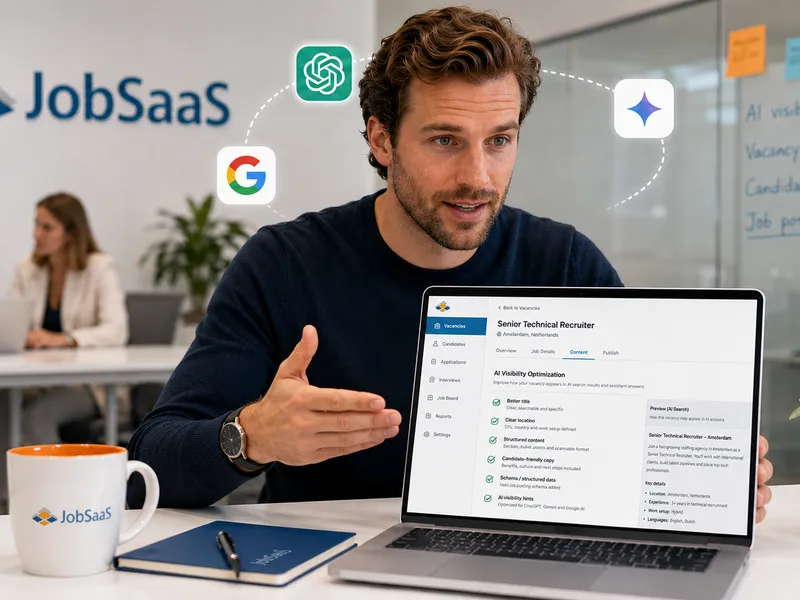
This is not a distant scenario. Google continues to expand AI Overviews and AI Mode across markets and eligible query types, displaying AI-generated summaries and responses alongside traditional search results. At the same time, some candidates use ChatGPT, Claude, Gemini and Perplexity to research roles, compare agencies and shortlist opportunities. When these systems use web search to answer current job-related questions, publicly accessible pages provide the source material they can retrieve, compare and cite. If your vacancies do not appear on a page that can be read this way, they are far less likely to feature in the answer.
Candidates are starting to use AI to look for work
The way some candidates research work is changing. Instead of only scrolling through a job board, a job seeker may open an answer engine and ask a plain question: which agencies near Rotterdam are hiring forklift drivers, what temp work pays best for evening shifts, or how to phrase a CV for a machine operator role. Some candidates already use generative AI tools to research roles, employers, salaries and application requirements before they apply.
For a staffing agency, this changes where the first impression can happen. A candidate may no longer start on your careers page, or even on Indeed, but inside a conversation where the AI decides which sources to draw on. If your vacancies are not readable to that AI, you can be absent at the moment someone is ready to apply. Being present in AI job search is becoming a useful complement to ranking in classic Google and Bing results, and it sits alongside your existing work on getting more candidates through your own website.
How AI answer engines can find a vacancy
AI answer engines do not invent jobs, and when they answer questions about live vacancies they generally rely on content they can retrieve rather than on your database or ATS. The process behind a web-grounded AI answer typically looks something like this:
- A candidate asks ChatGPT, Claude, Gemini or Perplexity a question in ordinary language.
- The system may reformulate that question into one or more search queries.
- It retrieves relevant pages from the web.
- It reads and compares the information on those pages.
- It generates a single answer grounded in what it found.
- It may cite or link some of the sources.
The combination of retrieving relevant information and using it to generate a grounded answer is commonly known as retrieval augmented generation, or RAG. Not every system works visibly or in exactly the same way, but the pattern explains why a readable, well-structured vacancy page matters: a page that cannot be retrieved and understood cannot inform the answer. Shaping pages so answer engines can find, interpret and cite them is often called generative engine optimisation, or GEO.
Conversational search changes how vacancies get matched
AI interfaces make it easier for candidates to use detailed, conversational questions rather than relying only on short keyword searches. A realistic query now looks like this: "I have a forklift certificate and live near Utrecht. Which staffing agencies have full-time warehouse jobs starting next Monday?" That single question contains a skill, a location, a contract type and a start date.
Your vacancy pages should answer questions like this implicitly. If the page states the required certificate, the city, the employment type and the start date in plain text and in structured data, a system has reliable information to match it against the candidate's question. If those details are missing, vague or difficult to retrieve, the system has less reliable information on which to base a match.
If essential vacancy details are difficult for a person to identify, they are also more likely to be ambiguous to search and AI systems. Pages that are clear, specific and easy to verify give search and AI systems more reliable information to work with.
What AI systems can actually read
Search crawlers need to access and process your pages before their information can become available to search indexes and web-connected AI systems. Although implementations differ, the same technical foundations improve retrievability. Vacancy pages that are easy to retrieve and interpret tend to share these characteristics:
- Crawlable HTML pages that load without a login.
- A unique, descriptive URL for every vacancy, with a canonical URL where duplicates exist.
- Internal links connecting related roles and supporting pages.
- An XML sitemap listing every live vacancy, and a robots.txt file that allows crawling rather than blocking it.
- JobPosting structured data that matches the visible content.
- Clear headings and plain text on the page, not only an image or an embedded file.
Some formats make this harder. Search engines can index PDFs, but a dedicated HTML vacancy page is generally a better primary format because it supports structured data, internal linking, responsive presentation and a clearer application journey. Google can render JavaScript, but JavaScript-heavy implementations introduce additional crawling and rendering complexity, so important vacancy content should remain reliably accessible in the rendered HTML rather than depending on blocked scripts or user interaction. Google's JavaScript SEO guidance explains this in more detail. Login pages and candidate portals are invisible to crawlers by design.
Crawler access is worth checking directly. Review Google's robots.txt documentation to confirm you are not accidentally blocking useful crawlers. For ChatGPT Search, check that your robots.txt file and hosting allow OAI-SearchBot. OpenAI treats this separately from GPTBot, which is associated with potential model training, so you can permit search visibility and still make a separate decision about training. OpenAI's crawler documentation sets out how this access works.
Traditional search and generative visibility
Generative engine optimisation is not a separate discipline that replaces SEO. It is better understood as an additional visibility outcome within modern search, built on the same foundations:
- Traditional search visibility: appear prominently among search results.
- Generative search visibility: be selected as a supporting source in a generated answer.
- Shared foundations: crawlability, indexing, relevance, quality, authority and a good user experience.
- Additional reporting: citations, mentions, referral traffic and conversions from AI interfaces, where these can be measured.
For Google AI Overviews and AI Mode, Google recommends the same foundational SEO practices rather than a separate set of GEO techniques. This is set out in Google's guidance for AI features and in Google's guide to generative AI search optimisation. A vacancy page built well for Google for Jobs is, for the same reasons, a page an answer engine can read.
How staffing agencies can improve their AI job search visibility
Improving AI job search visibility is mostly consistent housekeeping across every vacancy. These moves matter more than any single tactic.
Give every vacancy its own indexable page
Nothing else works without this. Each job needs a dedicated, crawlable detail page with a descriptive title and a stable URL. It may also appear in filtered search results, but the vacancy itself should not exist only inside a transient filter view, modal or JavaScript interaction. Getting this structure right is a large part of how to create a job board that both candidates and search systems can use. Note the distinction between the structured job title and the visible heading: the JobPosting title stays as the plain role name, for example "Warehouse Operative", while the page heading or SEO title can add context, such as "Warehouse Operative in Utrecht | Day Shift". Supporting details, like a preferred forklift certificate, salary, start date and employment type, belong in the description and structured data, not crammed into the title. A warehouse jobs in Utrecht landing page that loads on its own URL, at something like /vacancies/warehouse-operative-utrecht, is the difference between existing and being findable.
Add JobPosting structured data
Structured data gives search engines a standardised description of your vacancy. JobPosting structured data makes key details less ambiguous and supports eligibility for Google's job search experience, although it does not guarantee inclusion in an AI-generated answer, and there is no separate GEO schema. It should always match the visible content on the page, and, per Google's guidance, the title property should contain only the job name, not the location, salary or other attributes. Important required and recommended properties include:
- title: the role name, written the way a candidate would recognise it.
- description: the full, formatted job description.
- datePosted and validThrough: when the vacancy went live and when it expires.
- employmentType: full-time, part-time, temporary or contract.
- hiringOrganization: the agency or employer offering the role.
- jobLocation: the physical location for on-site roles, for example Utrecht, Rotterdam or Eindhoven.
- baseSalary: the pay or a realistic range, where available.
- identifier: a reference for the vacancy, where relevant.
Not every property applies to every vacancy. For fully remote roles, jobLocationType and applicantLocationRequirements describe where candidates may be based, rather than a single physical jobLocation. Follow the current documentation and the general structured data guidelines, and include all relevant required and recommended fields without adding information that is absent from the visible page.
Validate new templates with the Rich Results Test and inspect representative vacancy URLs in Google Search Console. Monitor the Job posting enhancement reports for invalid markup, expired listings and mismatches between structured data and visible content.
Write titles and copy the way candidates ask
Because candidates often search in sentences, your vacancy copy should answer the questions they type: the shift pattern, whether the role suits someone without experience, how quickly they can start and what it pays. The structured job title could be "Machine Operator", while the page heading or SEO title can naturally add context such as Eindhoven, day shift and entry-level suitability. That reads far more clearly to a candidate, and to a search system, than an internal reference like "Vacancy 4471". The same clarity supports strong vacancy optimisation more broadly.
Build supporting content around roles, sectors and cities
Even a detailed vacancy page benefits from supporting content that explains the role, sector, qualification or local labour market. Short guides on what a logistics job in a given region typically pays, what a specific certificate involves, or what a normal week looks like, signal that you know the roles you place. That makes web-connected AI systems more likely to draw on your site for broad questions, and turns the wider shift towards AI in recruitment for staffing agencies into an advantage rather than a threat.
Link your vacancy pages together
Internal links help crawlers and web-connected AI systems move through your site and understand how roles relate. Connect a logistics jobs in Rotterdam page to related warehouse and driver vacancies, and to any supporting guide. This is where a platform like JobSaaS earns its keep: it turns individual vacancies into a connected, SEO-ready structure with sensible internal links, rather than a set of orphaned pages nobody can navigate. If you are weighing up how job board software works, this connected structure is one of the clearest benefits.
Keep vacancy pages fresh
Freshness is especially important for vacancy content, because an expired or inaccurate job is no longer useful to a candidate. Correct dates and prompt handling of closed roles also support Google's JobPosting requirements and reduce the risk of outdated listings being surfaced. A few habits help:
- Keep salaries accurate and update them when the real rate changes.
- Keep datePosted honest and set validThrough so systems know when a role lapses.
- Refresh vacancy copy when requirements, shifts or start dates change.
- When a vacancy closes, remove its active JobPosting markup or set validThrough correctly, stop presenting an active application option and decide whether the page still has lasting value. Pages without useful ongoing content can return a 404 or 410; useful archived pages may remain available with a clear closed status and links to current alternatives.
- Avoid letting hundreds of stale pages accumulate, which reduces the reliability and usefulness of the information on your site.
Keep an XML sitemap, following Google's sitemap documentation, as the complete inventory of live URLs. For search engines that support IndexNow, submitting a URL when a vacancy is added, updated or removed can help those systems discover the change sooner; Bing's guidance on sitemaps in AI-powered search covers how this fits together. Treat it as an aid to discovery, not a guarantee of indexing or of inclusion in an AI answer. Publishing at volume calls for a system that handles this, not a manual clean-up each quarter.
What we commonly check on staffing agency websites
Based on our experience building and supporting recruitment and vacancy websites, the largest visibility problems are rarely caused by one advanced technical issue. They usually come from basic information being unavailable, inconsistent or difficult to retrieve. Common checks include:
- Vacancies that appear in a search or filter interface but do not have a stable, crawlable detail URL of their own.
- Missing structured data, or JobPosting markup that does not match the visible text.
- Key fields left blank, most often salary, employment type and a clear location.
- Closed roles that still appear active, contain active structured data or remain in sitemaps alongside current vacancies.
- Titles built for internal reference, such as "Vacancy 4471", rather than for how a candidate searches.
The fix is rarely dramatic. A role that started life as a filtered result labelled "Warehouse job" becomes a standalone page at /vacancies/warehouse-operative-utrecht, with a clear heading, salary, contract type and start date, and JobPosting markup that mirrors the visible copy, linked to related roles nearby. The same role, made retrievable.
Structure gets you found, authority gets you trusted
Clarity gets your vacancy retrieved. Clear sourcing, first-hand expertise and a credible website can then make content more useful and trustworthy to readers and search systems. Different answer engines use different retrieval and ranking systems, so no single authority signal guarantees a citation. Google describes the qualities of trustworthy, helpful content as experience, expertise, authoritativeness and trust, abbreviated E-E-A-T. It comes from the Search Quality Rater Guidelines and is a way of describing good content, not a direct ranking factor or a technical score you can set. Staffing agencies are well placed to demonstrate it through:
- Real experience placing candidates in a specific sector, year after year.
- Local knowledge of the markets you serve, from Utrecht warehousing to Eindhoven manufacturing.
- Named, visible recruiters with genuine expertise, rather than anonymous listings.
- Long-standing relationships with the employers you represent.
- Quality content around the functions and industries you recruit for, tied to a strong candidate experience.
A specialist staffing agency can differentiate itself from generic aggregators by publishing first-hand sector knowledge, local labour-market insight and clearly attributable recruiter expertise, following Google's guidance on helpful, reliable content. These are signals that can make the content more useful, distinctive and trustworthy.
Frequently asked questions
Do candidates use AI to find jobs?
Some already do. A candidate may use ChatGPT, Gemini or Perplexity to research which agencies are hiring, what a role pays, or how to present their CV, then apply through a job board or directly. It is an emerging behaviour rather than a universal one, but it is worth preparing for now.
How is AI job search different from traditional Google search?
Classic Google and Bing search return a list of links to choose from. Answer engines, including Google AI Overviews, return a synthesised answer and may cite only a handful of sources. That raises the bar: appearing on page one is not always enough, because your vacancy needs to be clear and structured enough to be a source the system draws on.
Do I need JobPosting structured data to appear in AI search?
It is not strictly required, and Google notes that structured data is not a prerequisite for appearing in generative results. It still helps: it removes ambiguity about your page and supports eligibility for Google's job search experience. For agencies publishing at volume, it is a high-return technical step, provided the markup matches the visible content.
Can staffing agencies still rely on Indeed and LinkedIn?
They remain useful channels, but relying on them alone carries risk. You compete with everyone on the same platform, you pay for the visibility, and you do not own the resulting traffic or data. Building your own recruitment website alongside them gives you an asset that keeps working as candidate behaviour changes.
AI job search visibility checklist
Use this as a quick audit for every vacancy you publish.
- Every vacancy has its own unique, descriptive URL.
- JobPosting structured data is present, complete and matches the visible content.
- Salary, or a realistic range, is included where available.
- Location is stated clearly.
- Contract type is stated.
- Internal links connect the vacancy to related roles and guides.
- The page is listed in the XML sitemap.
- The page loads quickly and is crawlable and indexable.
- Crawlers you want, such as OAI-SearchBot, are not blocked.
- Closed vacancies show a clear status and are handled correctly.
Conclusion
Candidate behaviour is shifting faster than most recruitment marketing. As more candidates experiment with ChatGPT, Claude, Gemini and Perplexity during their job search, structured, crawlable and current vacancy pages give staffing agencies a stronger foundation for visibility across both traditional and generative search. Organisations that depend entirely on external job boards give search and AI systems fewer first-party pages from their own domain to discover, interpret and cite.
For staffing agencies that want more control over how candidates find them, JobSaaS offers a practical way to build a recruitment-focused job site that supports SEO, AI visibility and conversion, so your jobs stay findable wherever candidates choose to search next.