Indeed, LinkedIn and the larger paid job boards are useful. They are also a tax. Every sponsored slot, every cost-per-click campaign and every premium listing buys you applications you do not keep, on a platform whose pricing and ranking rules you do not control. When a board raises its rates or quietly changes how listings are shown, your candidate flow drops overnight — and there is nothing you can do about it.
This article looks at why that dependence builds up, what it actually costs a staffing agency, and how to reduce dependence on Indeed by building candidate acquisition channels you own.
Why staffing agencies become dependent on paid job boards
Dependence rarely starts as a decision. It starts as a shortcut. A new vacancy comes in, the deadline is tight, and posting to Indeed gets applications within hours. It works, so it becomes the default — and over time the agency forgets how to attract candidates any other way.
The pattern is familiar to most recruitment agencies, temp agencies and employment agencies:
- Speed over ownership. Paid boards deliver fast, so investment in an owned channel keeps getting postponed.
- No organic alternative. The agency website is a brochure, not a job site, so it captures almost no organic candidate traffic.
- Rising cost per hire. As more agencies compete for the same warehouse, logistics and care roles, cost-per-click climbs and margins shrink.
- Zero compounding value. Money spent on a sponsored listing disappears when the campaign ends. It builds nothing you keep.
The result is an agency whose entire candidate supply sits on infrastructure it neither owns nor controls.
What over-reliance on Indeed really costs
The cost is not only the invoice. Heavy reliance on a single paid channel creates three structural risks for a staffing agency.
You compete on price, not relevance
On a paid board, the agency willing to bid most for a click wins the visibility — regardless of who has the best roles or the strongest local brand. You are forced into an auction against competitors for the same candidates, which steadily pushes cost per application up.
You hand over the candidate relationship
When a jobseeker discovers your vacancy on a third-party platform, the platform owns that first impression and often the application data too. You become a fulfilment supplier rather than a recognised brand candidates seek out by name.
You have no fallback
A pricing change, a policy update or an algorithm tweak on a single board can cut your candidate flow in a week. An agency with no organic channel has no buffer when that happens.
If a single platform can switch off most of your candidate supply by changing one setting, that is not a marketing channel — it is a dependency.
How to get more candidates without paid job boards
Reducing dependence does not mean abandoning Indeed overnight. It means building owned channels alongside it until paid boards become a supplement rather than the foundation. Here is how staffing agencies attract more candidates without paid job boards.
1. Make every vacancy its own indexable page
Get more candidates via your own website by ensuring each job is a real, crawlable URL rather than a record trapped inside a search widget. A page with a clear title such as "Warehouse Operative – Utrecht" can rank in Google, appear in Google for Jobs and be cited by AI answer engines. A listing that only loads through JavaScript after a search is invisible to all three.
Practical actions:
- Give every vacancy a static, indexable URL with a descriptive, keyword-led title.
- Add JobPosting structured data so roles are eligible for Google for Jobs.
- Keep filled roles redirecting sensibly rather than returning dead pages.
2. Build role and location landing pages
Most candidate searches are not for your brand — they are for a role in a place. People search "warehouse jobs in Utrecht" or "machine operator in Eindhoven", not "[your agency] vacancies". Dedicated landing pages for your recurring role-and-location combinations capture exactly that intent.
For a staffing agency that places the same role types every month, these pages compound: they keep ranking and bringing in warehouse jobs in Utrecht traffic long after a paid campaign would have ended. This is where a platform like JobSaaS can help, by generating SEO landing pages for filters and categories automatically instead of as one-off manual builds.
3. Connect your pages with internal links
Isolated pages rank poorly. Link individual vacancies to their parent role or location page, and link related categories to each other, so both candidates and search engines can navigate the structure. Internal linking also spreads ranking strength to deeper vacancy pages that would otherwise sit unseen.
4. Optimise for AI search, not only Google
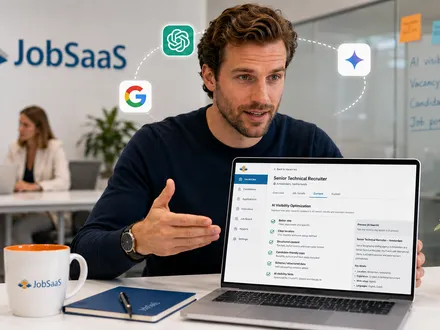
Candidates increasingly ask ChatGPT, Claude or Google AI Overviews where to find work. To get more candidates without Indeed, your job site needs to be the source these systems can read and cite: clean URLs, clear titles, structured data and concise role descriptions that directly answer "what jobs are available in this area". AI search visibility is becoming a candidate acquisition channel in its own right.
5. Capture and re-engage candidates you already attract
Every applicant who reaches your own site is a relationship you keep. Capture details, build a talent pool, and re-engage past candidates for new roles by email instead of paying a board to reach them again. The candidates you already have are the cheapest source of your next placement.
A realistic path to reduce dependence on Indeed
You do not need to abandon paid boards. You need a plan to shift the balance over time.
- Measure the baseline. What share of placements currently originate from paid boards? You cannot reduce a dependency you have not quantified.
- Fix the foundation. Make vacancies indexable and add structured data so your own site can rank at all.
- Build the high-intent pages. Create landing pages for your top recurring role-and-location combinations.
- Track owned-channel share. Watch organic and direct applications grow month on month.
- Rebalance spend. As organic flow rises, scale paid board spend back to where it genuinely adds reach rather than carries the whole pipeline.
The goal is not zero paid spend. It is becoming less dependent on Indeed and paid job boards, so that paid channels are a choice rather than a lifeline.
A well-established principle worth applying
Google's documented best practices for search are clear that a page must be crawlable and have a descriptive, specific title to be eligible for organic visibility. For a staffing agency this is the practical line between a vacancy that exists only as a database entry and one that can actually rank, appear in Google for Jobs and be surfaced by AI answer engines. Every job needs its own indexable page, a specific title and supporting internal links — without that foundation, no amount of content marketing will reduce your reliance on paid boards.
Frequently asked questions
How can a staffing agency get more candidates without Indeed?
By turning its own website into a true job site: each vacancy as an indexable page, role and location landing pages targeting searches like "logistics jobs in Rotterdam", structured data for Google for Jobs, and internal links connecting it all. This builds organic candidate traffic that does not stop when a campaign budget runs out.
Is it realistic to become less dependent on paid job boards?
Yes, but gradually. Most agencies start with their site contributing almost nothing organically and shift the balance over several months as landing pages begin to rank. The aim is to make paid boards a supplement, not the foundation, of candidate acquisition.
Why do agency websites usually fail to attract candidates organically?
Because their vacancies are not indexable. If jobs load only through a JavaScript search widget, have no individual URLs and lack structured data, Google and AI systems cannot read them. The site exists but is effectively invisible for the role-and-location searches candidates actually make.
Conclusion
Over-reliance on Indeed and paid job boards is a margin problem and a control problem. Every euro spent on a sponsored listing buys a candidate you do not keep, on a platform you do not own. The way out is not a bigger budget — it is an owned channel. By making vacancies indexable, building role and location landing pages, linking them properly and optimising for both Google and AI search, a staffing agency can steadily get more candidates via its own website and reduce dependence on Indeed without losing the reach paid boards still offer.
For staffing agencies that want more control over candidate acquisition, JobSaaS offers a practical way to build and manage a job site that supports SEO, AI visibility and conversion — so your pipeline rests on an asset you own rather than a channel you rent.