Why AI makes your own talent pool more important
The short version: the platforms you rent your reach from are changing the rules faster than ever, and AI is accelerating it. That's why the logic is shifting from "advertise where the candidates are" to "build a talent pool you control." Gartner predicts that traditional search volume will fall by roughly a quarter by 2026 as users move to AI chatbots and assistants. Research from the Pew Research Center also shows that people are far less likely to click through to an outside site when an AI summary sits at the top of the search results. That hits the exact model many staffing agencies run on: paying for a click that increasingly never comes.
For years the deal was simple. You paid Indeed or LinkedIn, and they sent you candidates. That deal still works, but it's getting more expensive and less predictable. Cost per click keeps climbing, a platform can bury your jobs overnight, and when an AI answer satisfies a job seeker without a click, the click you paid for simply doesn't happen. If you don't own any part of that pipeline, you feel every change first and hardest.
What AI really changes about recruiting
Recruiting is everything an agency does to reach candidates: job postings, organic search results, referrals, and its own talent pool. What AI changes most is the "where" and the "how." People increasingly start a search in a conversation, not a search bar. They ask an assistant for "warehouse jobs near me" and read a summarized answer instead of scrolling through ten blue links.
That has two consequences, and both point toward owning a pool. First, traffic from any single platform gets harder to predict. Second, your visibility now depends on whether AI systems can find, read, and trust your content. That's the difference between SEO, getting found in Google, and GEO, getting cited by AI answer engines. An agency that publishes clear, structured, genuinely useful content on its own site gives both systems something to show. An agency that lives only on someone else's platform gives them nothing.
Build your own talent pool in five steps
Building your own talent pool doesn't mean dropping Indeed or LinkedIn tomorrow. It means building assets you control, so those channels become a supplement instead of the whole engine. Now that AI is making outside traffic less predictable, this is what determines how much control you keep. Here's how to build and run a talent pool that's worth more every month.
1. Start with a careers site that's truly yours
Your careers site is the foundation under any talent pool. Every role belongs on its own indexable job page, with a clear, specific title, a solid description, and a way to apply or sign up. A job that exists only as a line item inside Indeed can't rank in Google and can't be cited by an AI assistant. A job with its own page on your site can do both.
2. Capture your talent pool with alerts and sign-ups
This is where the talent pool actually takes shape: traffic you don't capture is traffic you lose. The beauty of owning your site is that you own the relationship, too. Offer job alerts by role and location. Let candidates register with a resume in under a minute. Build talent pools for the roles you fill again and again.
Here's what that looks like in practice: a staffing agency with 3,000 candidates in its job alerts doesn't have to start over on Indeed clicks alone when a new warehouse role opens. You email the relevant people directly, while an ad budget starts back at zero every time. That database is worth more every month—especially when outside clicks are getting pricier and less certain.
3. Win organic and AI traffic with SEO and GEO content
Findable content is how candidates reach you without an ad. Build landing pages around the role-and-location combinations you recruit for, like warehouse jobs in Columbus or caregiver jobs in Phoenix. Answer the practical questions candidates actually type and say out loud: pay, shifts, requirements, and how to apply.
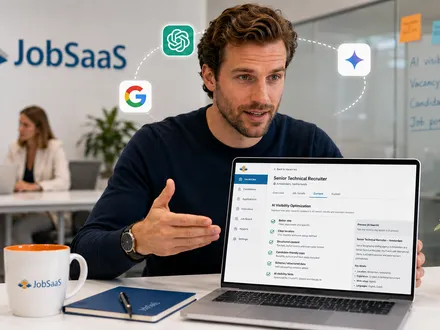
To stay visible in AI answers, structure that content so it can be cited. Start every page with a direct answer. Use clear headings, short paragraphs, and lists. Give honest, concrete details. AI systems pick content they can lift cleanly and trust, and your own site is the only place where you fully control how that content comes across.
4. Connect roles and locations with internal links
Internal links tell search engines and AI systems how your content fits together. Link a city page to the live jobs in that city. Link related roles to each other. Link a guide on CDL truck driver jobs in Memphis to the driving roles you actually have open. That spreads authority across your whole site and helps every page rank, not just the homepage.
5. Let your own assets do your ad budget's job
None of this shuts off paid channels overnight. It changes their role. As your organic traffic and your talent pool grow, you use ads for real spikes, not for basic survival. This is where a platform like JobSaaS can help: you publish a fast, findable careers site without a custom build, so every job becomes a page that can be found, indexed, and cited. Practical first steps:
- Give every live job its own indexable page with a descriptive title.
- Add job alerts and a one-minute sign-up to capture interested candidates.
- Build landing pages for your most-recruited role-and-location combinations.
- Link related pages to each other so authority and candidates flow between them.
- Measure how many placements come from your own site versus paid boards, and shift budget as the balance changes.
Watch out: keep your talent pool privacy-compliant
A talent pool is only worth something if it's handled properly. The moment you store candidate data or reach back out to people about roles down the line, privacy rules come into play. In the U.S. there's no single federal equivalent of Europe's GDPR—instead it's a patchwork. State laws matter most here: California's CCPA, as expanded by the CPRA, now covers job applicant and candidate data, and other states are adding their own rules. At the same time, federal anti-discrimination rules from the EEOC require you to keep certain application records for a set period, so the goal isn't simply to delete fast—it's to keep what you must, protect it, and be clear with candidates about it.
Turn that into a few concrete commitments in your process:
- Get active, voluntary consent before you add someone to your talent pool.
- Set a clear retention period and stick to it.
- Be transparent: tell candidates what you use their data for and how long you keep it.
- Make opting out as easy as opting in, with an unsubscribe link in every job alert.
This isn't a brake on your talent pool—it's the foundation of trust. A candidate who knows you handle their data carefully is more likely to sign up and more likely to stay in your pipeline.
Renting reach gets you candidates today. A well-run talent pool you own gets you candidates next year, too, even as AI reshapes the search landscape again.
What Google itself says about this
Google Search Central's documented best practices are clear: a page has to be crawlable and have a clear, descriptive title to qualify for organic visibility. For jobs, Google goes a step further. With JobPosting structured data, a job page becomes eligible for an enriched display in the search results, including the Google job search experience. For a staffing agency, that's the practical difference between a job that exists only as a database row on someone else's platform and a job that can actually be found and displayed. The same qualities that help a page rank in Google, namely clarity, structure, and trustworthiness, are what make AI answer engines want to cite it, too.
Frequently asked questions
Why is building your own talent pool becoming more important because of AI?
Because AI is making traffic from search engines and job boards less predictable. AI summaries capture more and more searches without a click-through, and platforms keep adjusting prices and rankings. Building your own talent pool gives you a direct line to candidates that doesn't depend on those outside changes.
How do I build my own talent pool?
You build your own talent pool by turning visitors to your own careers site into sign-ups. Offer job alerts by role and location, let candidates register with a resume, and build talent pools by role. That gives you a database you control and that's worth more every month, instead of paying for reach over and over.
How long can I keep candidate data?
It depends on where you operate. There's no single federal retention period in the U.S.: EEOC rules require keeping certain application records for a minimum period, while state privacy laws like California's CCPA/CPRA give candidates rights over their data. A safe approach is to set a clear retention period, document why you keep data and for how long, get consent to stay in touch about future roles, and always offer an easy way to opt out.
How long before your own talent pool pays off?
Organic visibility builds over months, not days. That's why it works best alongside your existing channels, not as a switch you flip today. The sooner you publish indexable job and location pages and start collecting candidates in your pool, the sooner that traffic and that database compound.
Conclusion: build on ground that's yours
AI isn't the enemy of recruiting, but it does make outside traffic harder to predict. That's exactly why building your own talent pool matters more. The agencies that keep control are the ones that own their pipeline: a careers site they run, a privacy-compliant talent pool that compounds, and SEO and GEO content that earns visibility in both Google and AI answers. Building your own talent pool isn't a one-off project but an asset that grows with you; paid boards then become a tool you choose, not a dependency you can't escape.
For staffing agencies that want more control over recruiting, JobSaaS offers a practical way to build and run a careers site that supports SEO, AI visibility, and your own growing talent pool, without starting from scratch.